Brush Stroke Colored: A Practical Guide to Choosing the Right Artistic Assets
In the realm of digital design and creative crafting, the choice of visual assets often dictates the final tone and professionalism of a project. Among the various styles available, Brush Stroke Colored clipart has emerged as a versatile option for designers, scrapbookers, and small business owners alike. This style mimics the organic flow of hand-painted elements, offering a human touch that rigid vector shapes often lack. However, like any resource, it is not a one-size-fits-all solution. Understanding what makes this specific set distinct, how it compares to other artistic formats, and when it is the most appropriate tool can significantly streamline your creative workflow.
Defining the Brush Stroke Colored Aesthetic
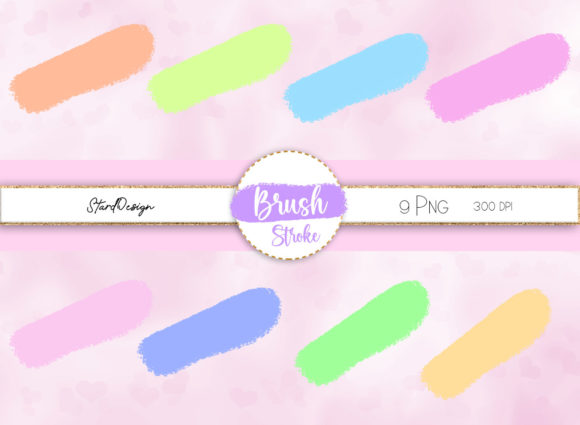
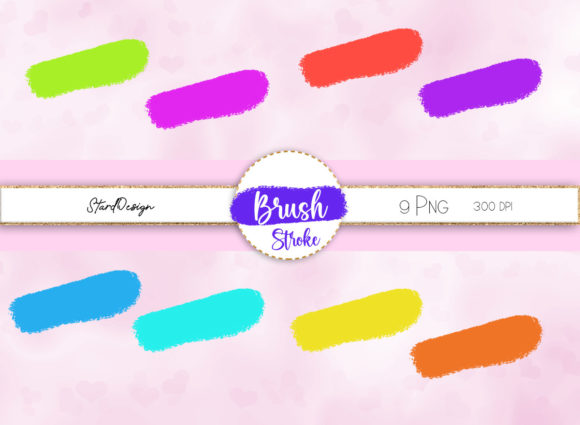
Brush Stroke Colored refers to digital graphics that replicate the appearance of paint applied with a brush. Unlike solid geometric shapes or flat illustrations, these assets feature varying line weights, textured edges, and color gradients that suggest movement and depth. The specific set in question includes nine high-resolution PNG files with transparent backgrounds, rendered at 300 dpi. This resolution is critical for print applications, ensuring that the details remain crisp even when scaled up for larger formats like invitations or fabric printing.
The distinctiveness of this style lies in its ability to bridge the gap between professional polish and handmade charm. In a digital landscape often dominated by sterile, perfect lines, the irregularity of a brush stroke introduces warmth and personality. Whether used as an accent on a business card or a decorative element in a photo album, these strokes provide a dynamic visual break that guides the viewer's eye without overwhelming the primary content.
Comparing Formats: PNGs vs. Vectors and JPEGs
When evaluating graphic resources, format compatibility is a primary decision factor. The Brush Stroke Colored set is provided in PNG format with a transparent background. This offers a significant advantage over JPEGs, which typically include a white or colored box around the image, requiring additional editing time to remove. For projects involving layering—such as collages, planner stickers, or web graphics—the transparency allows the strokes to sit naturally over photos or patterned paper.
However, a comparison with vector formats (such as SVG or EPS) reveals important tradeoffs. Vector graphics are mathematically defined, meaning they can be scaled infinitely without losing quality. While the 300 dpi PNGs in this set are excellent for standard print sizes and web use, they may lose sharpness if stretched to billboard dimensions or extremely large banners. If your project requires frequent resizing across vastly different scales, a vector alternative might be more robust. Conversely, for fixed-size applications like letterhead, stationary, or standard business cards, the PNG format is often more user-friendly and immediately compatible with most design software.
Evaluating Use Cases: Where This Style Excels
The versatility of Brush Stroke Colored assets makes them suitable for a wide array of applications, but they shine brightest in specific contexts where texture and emotion are paramount.
- Planner Stickers and Scrapbooking: These hobbies rely heavily on personalization. The organic nature of brush strokes complements handwritten notes and physical photos better than rigid clipart. The transparent background ensures they adhere seamlessly to planner pages or scrapbook albums without unsightly borders.
- Web Design and Invitations: In digital spaces, users respond well to designs that feel approachable. Using these strokes as dividers or accents on invitation websites can soften the aesthetic, making the event feel more intimate. Similarly, on corporate sites, a subtle brush stroke can add a creative flair to otherwise formal layouts.
- Fabric Printing and Home Decor: The 300 dpi resolution supports high-quality reproduction on textiles. When printed on fabric for home decor items or clothing, the variation in the stroke width adds a tactile quality that enhances the overall design.
- Cardmaking and Business Cards: For small businesses, standing out is essential. Incorporating a colored brush stroke into a logo or card design can signal creativity and attention to detail, distinguishing the brand from competitors using generic templates.
Tradeoffs and Limitations to Consider
While the benefits are clear, a balanced evaluation requires acknowledging potential limitations. The primary constraint of a pre-made clipart set is the fixed nature of the designs. Unlike creating custom artwork from scratch, you are limited to the nine specific strokes included in the collection. If your project demands a unique shape or a very specific color palette that cannot be easily adjusted within your design software, these assets may require too much modification to be efficient.
Additionally, the "hand-painted" look is subjective. In highly technical or minimalist industries, such as engineering or strict corporate finance, the casual vibe of a brush stroke might appear unprofessional. It is crucial to align the asset's style with the brand identity or the emotional tone of the project. Overuse can also lead to visual clutter; because brush strokes are inherently dynamic, placing too many in a single composition can make the design feel chaotic rather than cohesive.
Decision Factors: Is This Set Right for You?
Determining whether the Brush Stroke Colored set is the right choice depends on several practical factors. First, consider your technical requirements. If you need files that are ready for immediate print at high quality without complex editing, the 300 dpi PNGs with transparent backgrounds offer a streamlined solution. They eliminate the need for tracing or background removal, saving valuable time in the production process.
Second, evaluate the scale of your project. For individual craft projects, party decorations, or small-batch stationery, this set provides sufficient variety and quality. However, for large-scale commercial campaigns requiring consistent branding across multiple media types, investing in a custom illustration service or a larger library of vectors might be a more strategic long-term investment.
Finally, think about the desired aesthetic outcome. If your goal is to evoke feelings of creativity, warmth, and approachability, these assets are an excellent fit. They work particularly well in projects like photo albums, scrapbook albums, and DIY craft projects where the human element is celebrated. If, however, your priority is absolute precision, uniformity, or scalability beyond standard print sizes, you may need to explore alternative resources.
Practical Integration Strategies
To maximize the value of these assets, consider how they interact with other design elements. Because the strokes are colored, they should harmonize with your existing palette rather than clash. Using them as framing elements for text on a letterhead or as background textures for web graphics can create depth without dominating the layout. In collage work, layering these strokes over photographs can help blend disparate images into a unified composition.
For those involved in fabric printing or creating home decor items, testing the colors before full production is advisable. Screen settings often differ from print outputs, so verifying that the hues translate correctly to your chosen medium is a prudent step. The transparency of the PNG files facilitates this process, allowing you to preview the strokes against various background patterns digitally before committing to physical materials.
Ultimately, the Brush Stroke Colored set serves as a powerful tool for enhancing visual communication when used intentionally. By understanding its strengths in providing texture and emotion, as well as its limitations regarding scalability and customization, creators can make informed decisions that elevate their work. Whether for a personal scrapbook album or a professional business card, the right artistic assets can transform a good design into a memorable experience.